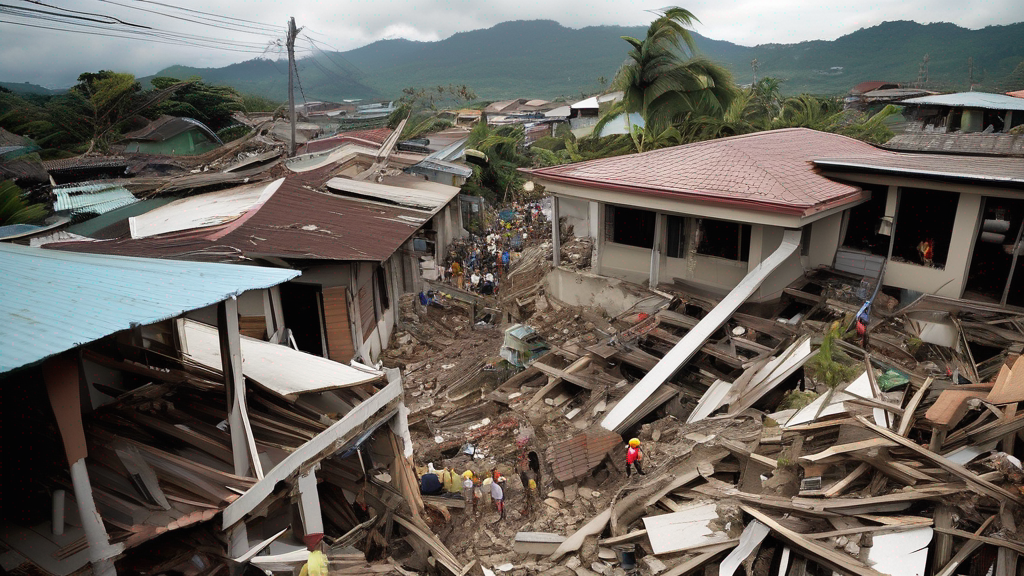
The ground gave way without warning on Wednesday, sending buildings crumbling and sparking frantic evacuations across the southern Philippines as a powerful earthquake tore through the region.
The quake, measured at magnitude 7.6, struck off the coast of Mindanao, one of the country’s largest and most populated islands. It hit in the early hours of the morning, catching many residents completely off guard and fast asleep.
Footage circulating on social media showed concrete structures reduced to rubble, with dust still billowing as locals scrambled through the debris. At least several multi-storey buildings in Surigao del Sur province are reported to have partially or fully collapsed, and rescue teams were deployed almost immediately.
The Philippine Institute of Volcanology and Seismology issued a tsunami warning covering coastal areas across multiple provinces, urging residents to move inland or to higher ground without delay. Thousands of people reportedly fled their homes within minutes of the alert, some carrying nothing but the clothes on their backs.
A local government official in Surigao City described scenes of panic, with residents rushing towards evacuation centres set up in schools and community halls.
“People were running, some crying, not knowing whether the wave would come or not. We just told them to move.”
The tsunami warning was eventually downgraded after initial wave measurements came in lower than feared, but authorities urged coastal communities not to return home until an all-clear was formally issued. It’s the kind of cautious approach that saved lives during previous Pacific disasters.
The Philippines sits squarely on the Pacific Ring of Fire, a horseshoe-shaped belt of seismic and volcanic activity that accounts for around 90% of the world’s earthquakes. The country experiences hundreds of quakes every year, though tremors of this magnitude are far less frequent.
Search and rescue operations are ongoing, and the full scale of casualties and structural damage won’t be clear for some time. Power outages and damaged roads are hampering access to some of the worst-affected areas.
As the relief effort gets underway, the bigger question looms; with climate pressures increasing coastal vulnerability across Southeast Asia, how prepared are communities for the next time the earth decides to move?