The skies over the Gulf are uneasy tonight, and nobody’s quite sure yet what that means.
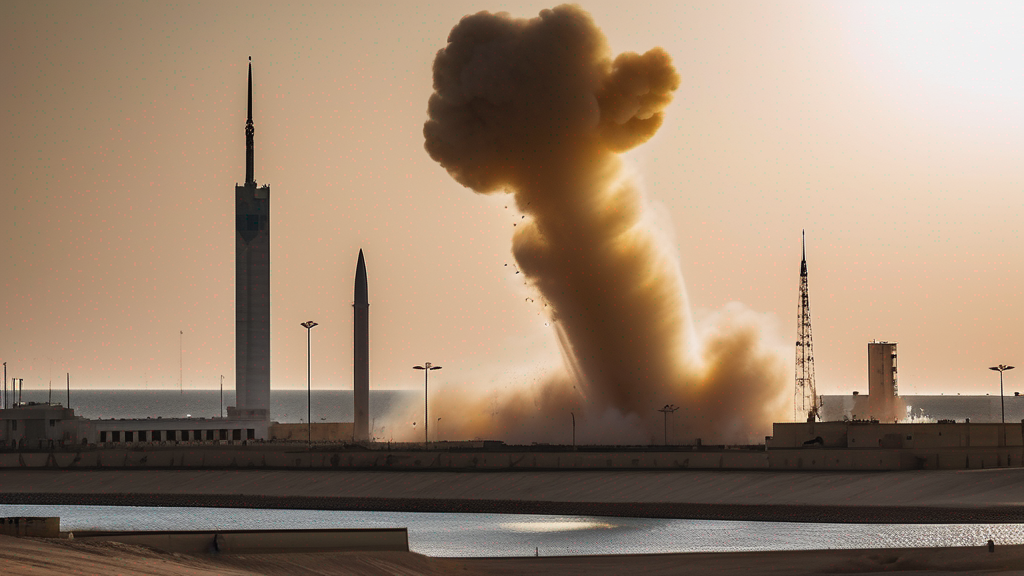
Kuwait’s military confirmed on Tuesday that its air defence systems had been activated to intercept incoming missiles, as reports of loud, explosion-like sounds emerged from near Iran’s Qeshm island, a strategically significant strip of land sitting at the mouth of the Strait of Hormuz. That’s roughly a third of the world’s seaborne oil passing through nearby waters, which puts the stakes into sharp perspective.
Qeshm is no ordinary patch of coast. It hosts Iranian naval assets and sits close to the Hormuz chokepoint. Any military activity in that vicinity tends to send shockwaves far beyond the immediate geography.
Kuwaiti officials were characteristically sparse with detail in their initial statement, confirming only that the interceptions had taken place and that the situation was being “closely monitored.” Residents in parts of southern Kuwait reportedly described hearing distant booms, though it remains unclear whether those sounds were connected to the interceptions or originating separately.
Iran’s state media had not, as of early reporting, issued any acknowledgment of activity near Qeshm. That silence is itself telling. Tehran has historically been slow to confirm or deny incidents that might expose a vulnerability or provoke further escalation.
“The Strait of Hormuz is one of the most sensitive corridors on the planet,” one regional security analyst noted earlier this year. “Any incident there, however contained it appears, carries the potential to spiral rapidly.”
Regional tensions have been simmering for months, shaped by the broader conflict dynamics stretching from Gaza northward through Lebanon and into the Red Sea. Houthi missile activity has already rattled shipping lanes significantly since late 2023; a new flashpoint near Iran’s southern coast would add another volatile layer entirely.
The situation is being updated in real time, and the picture remains fragmented. What we know is limited; what we don’t know is rather more significant.
Whether this proves to be a contained exchange or the opening note of something louder is the question every defence ministry from London to Washington is asking right now.